The relationship between China and Taiwan remains one of the most closely watched security issues in East Asia. Military activity, maritime patrols, political statements, and growing attention from neighboring countries have kept the Taiwan Strait at the center of regional security discussions.
Recent developments show that the situation is not defined by a single event. Instead, pressure is increasingly visible across several areas, including military readiness, coast guard operations, maritime activity, diplomacy, technology, and economic security. Understanding these developments requires looking beyond individual headlines and examining the broader pattern.
This article explains what recent actions reveal about China-Taiwan tensions, why activity around Taiwan matters beyond the island itself, and how developments could affect regional trade, travel, technology, and international relations.
Why China-Taiwan Tensions Matter
Taiwan sits in a strategically important position in the western Pacific. Its location places it between mainland China and major maritime routes extending toward Japan, the Philippines, and the wider Pacific.
For Beijing, Taiwan is a central issue of national sovereignty and reunification. Taiwan, meanwhile, operates with its own democratic government, military, economy, and institutions. The different political positions of Beijing and Taipei make the Taiwan Strait a persistent source of tension.
The issue also extends beyond China and Taiwan. The United States has longstanding security interests in the region, while Japan and the Philippines have direct geographic and maritime interests. As a result, developments around Taiwan can influence broader discussions about regional stability and international security.
Readers following other major international developments can also explore WayfareHub’s coverage of the Russia-Ukraine conflict and developments in Middle East peace talks to understand how geopolitical events can affect international relations.
Recent Military Activity Around Taiwan
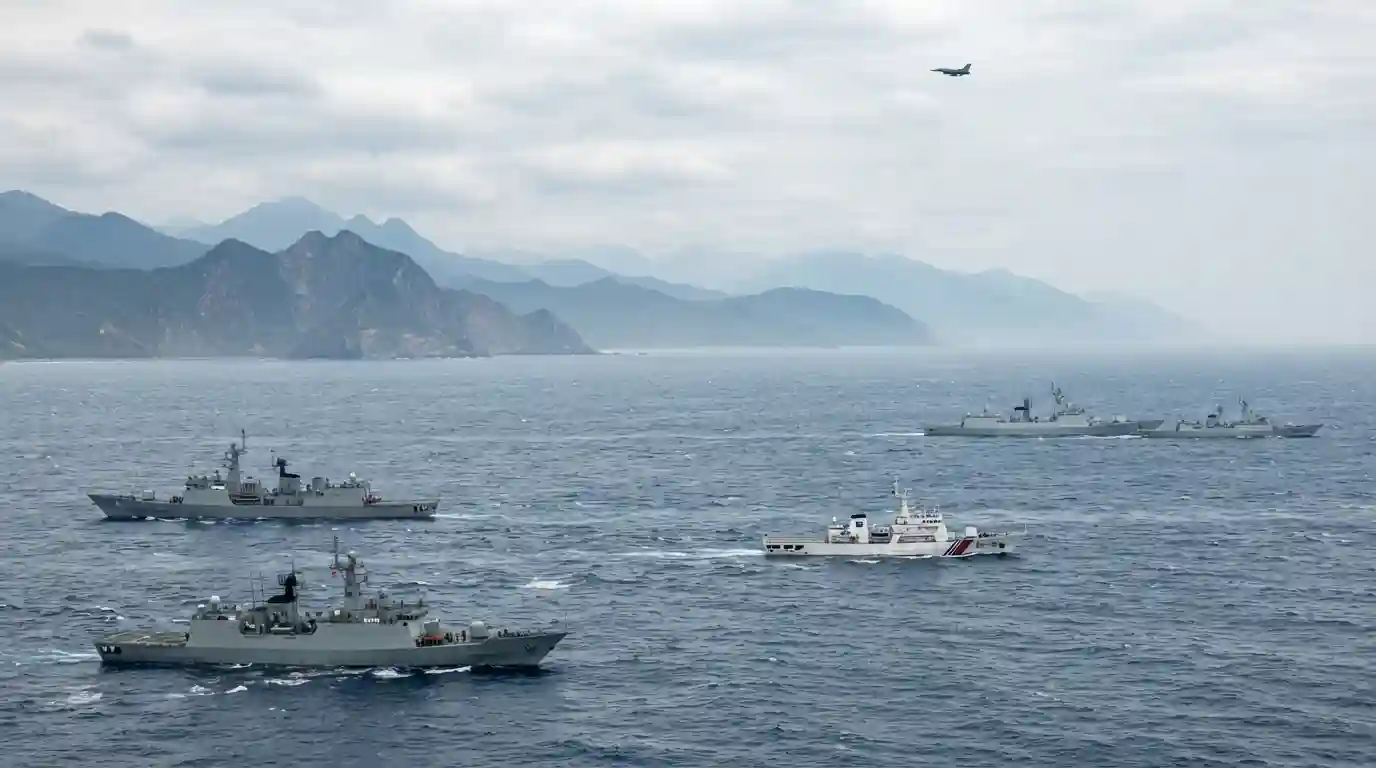
One of the clearest signs of continuing tension is the regular presence of Chinese military aircraft and naval vessels around Taiwan. Taiwan’s defense authorities routinely report activity involving aircraft, naval ships, and other official vessels.
Some Chinese aircraft have crossed the Taiwan Strait median line or entered areas that Taiwan monitors as part of its air-defense identification zone. These activities require Taiwan’s armed forces to monitor movements and respond according to its established procedures.
The significance of repeated activity is not necessarily that every incident represents an immediate preparation for conflict. Instead, the frequency of these operations can change the security environment by making military encounters more routine.
This gradual normalization is important because repeated exercises allow military forces to gather operational experience, test communication procedures, monitor responses, and demonstrate capabilities without necessarily moving directly into open conflict.
Live-Fire Exercises Add Another Layer of Pressure
Live-fire exercises in and around the Taiwan Strait attract particular attention because they demonstrate that military forces are practicing operations under conditions closer to real combat than routine patrols.
Recent exercises have included restricted maritime areas and navigation warnings. Such activity can affect commercial shipping and aviation planning while also giving military planners opportunities to test coordination and readiness.
For Taiwan, the challenge is balancing military preparedness with the need to avoid unnecessary escalation. For China, military exercises can serve multiple purposes, including training, signaling, deterrence, and political messaging.
The distinction between signaling and preparation for actual conflict is therefore important. A military exercise can demonstrate capability without proving that a decision to launch an attack has been made.
China’s Growing Maritime Presence East of Taiwan
Another important development has been increased Chinese coast guard and maritime activity in waters east of Taiwan.
The eastern side of Taiwan faces the Pacific and has historically been viewed differently from the heavily monitored waters west of the island. Increased Chinese coast guard activity in this area therefore carries strategic significance because it expands the geographic scope of maritime operations.
China has described some of these activities as law-enforcement or maritime operations. Taiwan has viewed the increased presence as part of a broader pressure campaign. Analysts have also examined whether repeated patrols could gradually establish a more persistent Chinese presence in waters that were previously less frequently associated with Chinese official vessels.
This is an example of what is often described as gray-zone activity. Such actions remain below the threshold of conventional armed conflict while still creating pressure and testing the other side’s response.
What Gray-Zone Pressure Means
Gray-zone activity can include coast guard patrols, maritime inspections, military aircraft operations, drones, research vessels, information operations, and other activities designed to advance strategic objectives without starting a conventional war.
The approach creates a difficult problem for the targeted side. Responding too weakly can allow a new activity to become normalized, while responding too aggressively can increase the possibility of an unintended confrontation.
This dynamic is not unique to the Taiwan Strait. Similar patterns can be observed in other disputed maritime areas, where governments use coast guard vessels and other nontraditional security tools to reinforce territorial or jurisdictional claims.
Taiwan’s Response and Defense Preparation
Taiwan has continued to strengthen its defense preparations while conducting its own military exercises. These preparations increasingly emphasize multiple forms of modern warfare, including air defense, anti-ship capabilities, drones, communications, civil defense, and resilience against disruption.
The objective is not limited to preparing for a conventional invasion. Taiwan must also consider scenarios involving blockades, cyber disruption, information warfare, attacks on critical infrastructure, and attempts to restrict transportation or communications.
Modern military planning therefore involves much more than aircraft and missiles. Communications networks, transportation systems, energy infrastructure, ports, telecommunications, and civilian preparedness can all become strategically important during a major crisis.
Why Japan and the Philippines Are Watching Closely
Japan and the Philippines have particularly strong reasons to monitor developments around Taiwan because of their geographic proximity and maritime interests.
Japan’s southwestern islands are relatively close to Taiwan, while the Philippines sits south of Taiwan and controls important maritime approaches into the western Pacific. Any major disruption in the Taiwan Strait could therefore create security and economic concerns for both countries.
Japan’s broader regional security discussions increasingly consider developments involving China, Taiwan, maritime routes, and the country’s southwestern islands. Travelers interested in the wider Japanese region can also explore WayfareHub’s guides to places to visit in Japan and Japan’s major travel destinations.
For travelers considering the wider East Asian region, WayfareHub also covers travel costs and conditions in Hong Kong, providing another perspective on the region’s interconnected travel environment.
The Economic Dimension of China-Taiwan Tensions
Security concerns around Taiwan are also closely connected to the global economy. East Asia is one of the world’s most important manufacturing and shipping regions, and disruption in the Taiwan Strait could affect businesses far beyond the immediate area.
Taiwan is particularly important to the global semiconductor industry. Advanced chips are used in smartphones, computers, vehicles, industrial equipment, artificial intelligence systems, and many other technologies.
A prolonged disruption could therefore create supply-chain challenges for manufacturers in different countries. Shipping delays, higher insurance costs, increased transportation expenses, and uncertainty around production could also have wider economic effects.
WayfareHub’s broader coverage of global economic shifts and its discussion of economic impact provide additional context for understanding how geopolitical developments can influence markets and businesses.
Technology Is Becoming More Important
Technology is another major dimension of the Taiwan issue. Semiconductors are central to modern computing, telecommunications, vehicles, industrial systems, and artificial intelligence.
This means Taiwan’s security is connected not only to traditional military strategy but also to technology supply chains. A serious disruption could affect companies that depend on advanced components even when those companies are thousands of miles away from the Taiwan Strait.
The wider growth of artificial intelligence makes semiconductor availability even more significant. Readers interested in the technological side of today’s global environment can also explore WayfareHub’s coverage of recent AI innovations.
Trade Routes and Maritime Security
The Taiwan Strait is part of a broader network of maritime routes connecting East Asian economies with markets around the world. Commercial vessels use the surrounding waters to transport energy products, manufactured goods, raw materials, and consumer products.
A serious crisis could therefore have consequences for shipping schedules and logistics. Even without a direct military conflict, uncertainty can cause companies to reconsider routes, increase inventories, adjust insurance coverage, or seek alternative suppliers.
The wider importance of global transportation can also be seen through WayfareHub’s coverage of modern supply-chain infrastructure and logistics and supply-chain activity.
What Recent Actions Reveal
Several broad patterns emerge from recent developments.
1. Military activity is becoming more routine
Repeated aircraft and naval activity means that military encounters around Taiwan are no longer unusual events. This increases operational familiarity but also creates more opportunities for miscalculation or accidents.
2. Maritime pressure is expanding geographically
Increased coast guard and research activity east of Taiwan demonstrates that maritime operations are extending beyond the most familiar areas around the Taiwan Strait.
3. Military and civilian agencies increasingly overlap
Coast guard operations, maritime research, military exercises, and commercial shipping can interact in the same geographic environment. This makes the distinction between civilian and military activity more complicated during periods of tension.
4. Taiwan is preparing for multiple scenarios
Taiwan’s defense planning increasingly addresses not only conventional attacks but also blockades, cyber disruption, drone activity, communications problems, and infrastructure threats.
5. The consequences extend beyond Taiwan
Japan, the Philippines, the United States, global manufacturers, shipping companies, and technology businesses all have interests connected to stability in the region.
Could Tensions Affect Travel?
Travel is another area where regional security developments can become relevant. A major deterioration in the situation could affect flight routes, maritime transportation, insurance arrangements, and travel advisories.
However, routine military activity does not automatically mean that ordinary travel across East Asia is disrupted. Travelers should distinguish between normal regional security developments and specific official warnings affecting a destination.
For broader travel planning, WayfareHub also provides guides covering destinations in the Philippines, Indonesia travel destinations, and Hawaii’s Big Island.
What Businesses Should Watch
Businesses with exposure to East Asian manufacturing and logistics should pay attention to more than military headlines. Important indicators include shipping disruptions, semiconductor availability, insurance costs, export controls, diplomatic developments, and changes in transportation routes.
Companies operating internationally may also need to consider how geopolitical uncertainty affects suppliers and customers. The lessons from other international crises demonstrate why diversification and supply-chain visibility can matter when regional conditions change.
WayfareHub’s coverage of the global impact of digital marketing and digital strategies for growing businesses can also provide broader business context for companies operating across international markets.
The Role of the United States
The United States remains an important factor in the Taiwan security environment. Washington maintains unofficial relations with Taiwan and has longstanding policies concerning Taiwan’s ability to defend itself.
At the same time, the United States also maintains diplomatic relations with the People’s Republic of China. Managing those relationships creates a complex strategic environment in which military deterrence, diplomacy, economic interests, and regional alliances all interact.
WayfareHub has also covered broader U.S. political developments, including the 2024 U.S. election and its major developments. Political changes in Washington can be relevant to international policy, although individual events should be evaluated on their own facts.
Why Escalation Is Difficult to Predict
Military activity can indicate increased pressure without establishing that a conflict is imminent. Governments frequently use exercises and patrols for several purposes at the same time, including training, signaling, deterrence, domestic messaging, and testing responses.
That makes it difficult to interpret any single incident in isolation. A better approach is to examine patterns over time, including the frequency of exercises, geographic expansion of patrols, changes in military readiness, diplomatic communications, and economic measures.
The same principle applies to other international crises. Headlines can highlight a dramatic event, while the longer-term strategic picture may develop gradually.
What to Watch Next
Several developments will remain important for understanding the direction of China-Taiwan relations:
- Changes in the frequency and geographic scope of Chinese military activity around Taiwan.
- Further coast guard operations east of Taiwan.
- Large-scale military exercises or live-fire drills.
- Changes in Taiwan’s defense spending and military readiness.
- U.S. policy and arms-related decisions involving Taiwan.
- Japan and Philippines security cooperation.
- Developments affecting semiconductor and technology supply chains.
- Changes in commercial shipping activity around the Taiwan Strait.
- Diplomatic communication between Beijing, Taipei, Washington, Tokyo, and other regional governments.
Conclusion
China-Taiwan tensions are developing through a combination of military activity, maritime operations, political messaging, economic pressure, and regional security planning. Recent actions do not point to one simple explanation; instead, they demonstrate how competition around Taiwan is becoming increasingly multidimensional.
The growing presence of aircraft, naval vessels, coast guard ships, and research vessels means that the surrounding waters are becoming an increasingly important arena for strategic competition. At the same time, Taiwan’s defense preparations and the involvement of neighboring countries show that the issue has implications well beyond the island itself.
For businesses, travelers, technology companies, and policymakers, the most useful approach is to follow verified developments over time rather than interpreting every military movement as evidence of an immediate conflict. The Taiwan Strait remains a major regional security issue, and its future will continue to influence international trade, technology, diplomacy, and travel across the wider Indo-Pacific.