
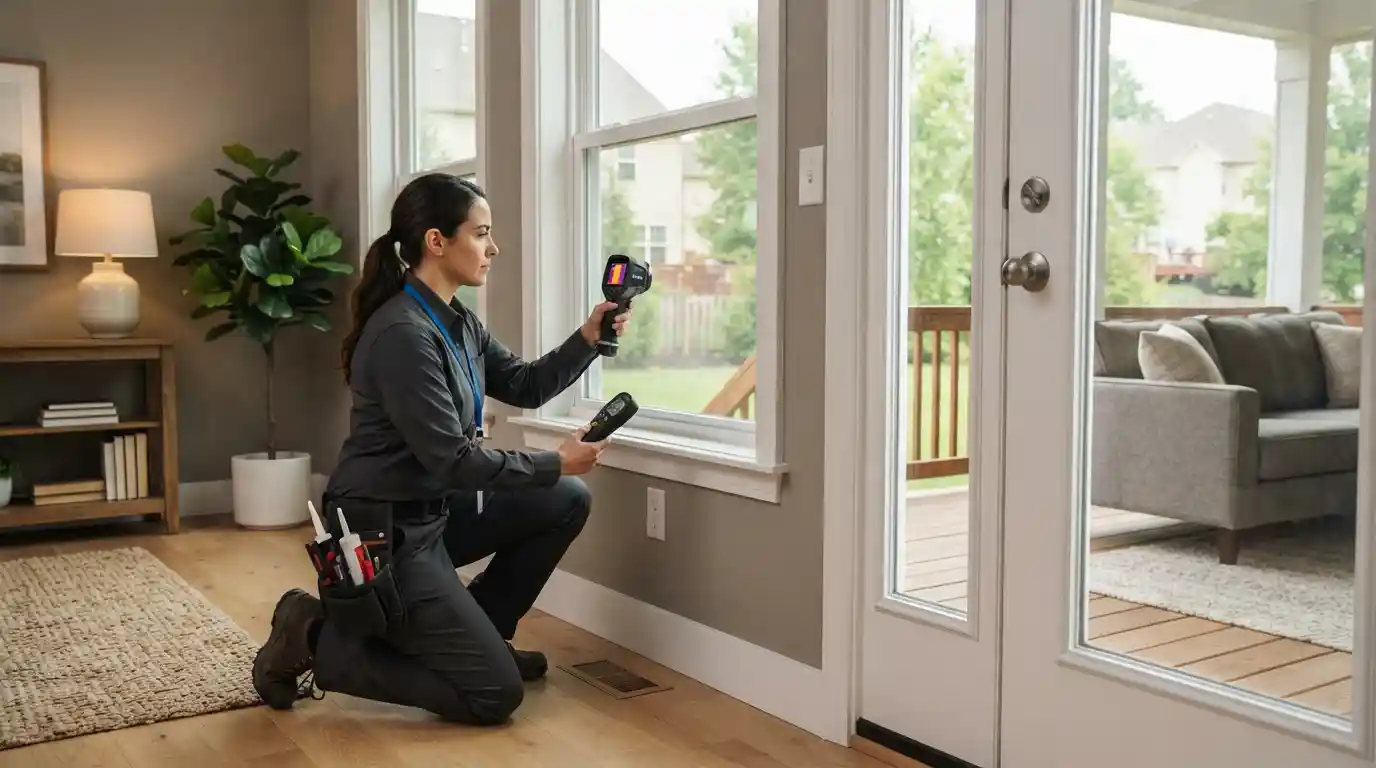
A comfortable, energy-efficient home starts with a strong building envelope. Even when your heating and cooling equipment is working properly, unwanted gaps around windows, doors, walls, attics, foundations, and service penetrations can allow conditioned air to escape and outdoor air to enter. Professional home sealing services help identify and address these weak points so your home can maintain a more consistent indoor environment.
What Is Professional Home Sealing?
Professional home sealing is the process of identifying and closing unwanted openings in the home’s exterior envelope. These openings can occur around windows and doors, electrical and plumbing penetrations, attic access points, foundations, vents, duct connections, and other areas where building materials meet.
Depending on the condition of the property, sealing work may involve caulking, weatherstripping, expanding foam, insulation improvements, air-barrier materials, or other appropriate techniques. The objective is to control unwanted airflow while maintaining the ventilation and moisture-management features the home needs.
For homeowners considering broader property improvements, sealing can be part of a larger strategy alongside real estate improvement and investment planning. A more efficient home can be more comfortable to occupy and potentially more attractive to future buyers.
Why Home Sealing Matters for Energy Efficiency
Heating and cooling systems consume energy to create comfortable indoor temperatures. When conditioned air escapes through uncontrolled openings, the system may need to operate longer to maintain the temperature selected on the thermostat.
This does not necessarily mean that every draft requires an expensive renovation. In many homes, relatively small leakage points can collectively create a meaningful comfort and efficiency problem. Finding and sealing those locations can therefore be a practical component of an energy-efficiency strategy.
Home sealing works particularly well when combined with other improvements. For example, homeowners planning home automation upgrades may also review temperature control and energy-management practices at the same time. Similarly, exterior projects such as concrete maintenance and exterior improvements can be evaluated alongside the condition of the home’s envelope.
Key Benefits of Professional Home Sealing Services
1. Better Indoor Comfort
Drafts can make some rooms feel noticeably colder or warmer than others. Air sealing helps reduce unwanted airflow through cracks and gaps, allowing the HVAC system to maintain more consistent indoor conditions.
This can be particularly useful in older homes where windows, doors, attic access points, or foundation areas may have developed gaps over time.
2. Reduced Energy Waste
When conditioned air stays where it belongs, the heating and cooling system may not need to compensate as frequently for unwanted air movement. The potential effect on utility costs depends on the home’s size, construction, climate, HVAC system, existing leakage, and energy usage patterns.
Rather than assuming a fixed amount of savings, homeowners should have problem areas evaluated and prioritize improvements according to their actual condition.
3. Fewer Drafts
Drafts are among the easiest signs of air leakage to notice. Cold air around a window, moving air beneath an exterior door, or temperature differences near an attic access panel can indicate areas that deserve closer inspection.
4. Improved Indoor Air Control
Uncontrolled openings can allow outdoor dust, pollutants, moisture, and other particles to enter the building. Sealing appropriate leakage points can help improve control over what enters the living space.
Air sealing should still be coordinated with appropriate ventilation because a healthy home needs controlled fresh-air exchange rather than simply eliminating every source of airflow.
5. Better Moisture Management
Air movement can transport moisture into parts of a building assembly where condensation may become a concern. Addressing leakage around vulnerable areas can therefore form part of a broader moisture-management strategy.
Homeowners dealing with significant moisture, visible mold, or structural deterioration should address the underlying problem rather than simply covering the affected area with sealant.
6. Support for HVAC Performance
A well-sealed home can make it easier for an HVAC system to maintain the desired indoor temperature. This does not replace necessary HVAC maintenance, but it can reduce one source of unnecessary heating and cooling demand.
For properties undergoing multiple upgrades, sealing should be considered alongside the overall condition of the home’s systems and structure.
Common Areas That Need Home Sealing
Air leakage does not occur in one universal location. Every property has its own weak points, but several areas deserve particular attention.
Windows and Exterior Doors
Windows and doors are common locations for drafts because they contain movable components and joints between different materials. Damaged weatherstripping, deteriorated caulk, poorly fitted frames, and gaps around the installation can all contribute to unwanted airflow.
Sealing around these areas can complement broader home improvement considerations for residential properties, especially when homeowners are preparing a property for long-term occupancy or resale.
Attic Access and Ceiling Penetrations
Attic areas can contain numerous penetrations for electrical wiring, plumbing, ventilation, lighting, and other building services. Attic access doors can also become leakage points if they are not properly fitted and sealed.
Because the attic is often outside the conditioned living space, uncontrolled airflow between the attic and living areas can have a noticeable effect on comfort and energy performance.
Basements and Foundations
Basements and foundation areas can contain cracks, gaps around utility penetrations, rim-joist leakage, and other openings. These locations may also be associated with moisture problems.
Sealing should therefore be approached carefully. If there is active water intrusion or structural damage, the cause should be investigated before an air-sealing solution is applied.
Plumbing and Electrical Penetrations
Whenever pipes, cables, ducts, or other services pass through walls, ceilings, or floors, small gaps can develop around the penetration. These openings may be easy to overlook because they are often hidden from everyday view.
Ductwork and Mechanical Areas
Duct leakage can contribute to energy loss even when the rest of the building envelope is relatively tight. Homeowners should distinguish between general building-envelope sealing and professional duct sealing because each requires a different inspection and repair approach.
How Professional Home Sealing Services Work
A professional project should begin with an assessment rather than immediately applying sealant everywhere. The goal is to identify the locations that matter most and select the appropriate method for each problem.
Step 1: Home Assessment
A technician reviews the condition of the property and looks for visible signs of air leakage, drafts, moisture problems, deteriorated materials, and construction gaps.
Depending on the project, diagnostic equipment such as blower-door testing or infrared imaging may be used to locate less obvious leakage.
Step 2: Identify Priority Areas
Not every crack or opening has the same impact. Professionals can prioritize areas based on their location, size, accessibility, relationship to conditioned space, and potential effect on comfort or energy performance.
Step 3: Select the Appropriate Materials
Different gaps require different solutions. Small stationary gaps may be suitable for caulk, while larger openings may require expanding foam or other air-sealing materials. Doors and windows may require replacement or adjustment of weatherstripping.
Step 4: Complete the Sealing Work
The identified leakage points are sealed using materials appropriate for the surface and application. Professional workmanship is important because poorly applied materials may fail prematurely or leave hidden leakage paths untreated.
Step 5: Review the Results
After the work is complete, the property can be reviewed again to determine whether the major leakage problems have been addressed. In more comprehensive projects, repeat diagnostic testing can help identify remaining problem areas.
Professional Home Sealing vs. DIY Air Sealing
Some simple sealing tasks can be handled by homeowners. Replacing worn weatherstripping or applying suitable caulk around accessible, non-problematic areas may be reasonable DIY projects.
However, professional assistance becomes more valuable when leaks are difficult to locate, areas are inaccessible, insulation is involved, moisture is present, or multiple parts of the building envelope are affected.
A professional evaluation can also prevent a common DIY mistake: sealing the wrong area without addressing the underlying cause. For example, covering a visible crack without investigating moisture movement or structural deterioration may only hide a larger problem.
Homeowners planning larger property projects can also explore related topics such as residential property opportunities and finding the right property when comparing whether to renovate an existing home or invest elsewhere.
How Much Do Home Sealing Services Cost?
The cost of professional home sealing varies considerably. Property size, construction type, accessibility, the number of leakage points, existing insulation, labor requirements, and the materials needed can all influence the final price.
A small project involving weatherstripping and basic caulking can cost considerably less than a comprehensive air-sealing project involving attic work, insulation improvements, diagnostic testing, or difficult-to-access areas.
For that reason, homeowners should be cautious about relying on a single universal price range. A professional assessment and itemized estimate provide a more useful picture of what a particular property actually requires.
When evaluating home improvements, it can also be helpful to consider financing alongside the expected long-term value of the project. Homeowners exploring other comfort-related upgrades may find our guide to home improvement financing considerations useful for broader budgeting decisions.
How to Choose a Home Sealing Professional
Choosing the right contractor is just as important as selecting the right sealing materials. Homeowners should look for a provider with relevant experience, appropriate licensing and insurance where required, transparent pricing, and a clear explanation of the proposed work.
Ask About the Inspection Process
A reputable provider should be able to explain how leakage will be identified and