
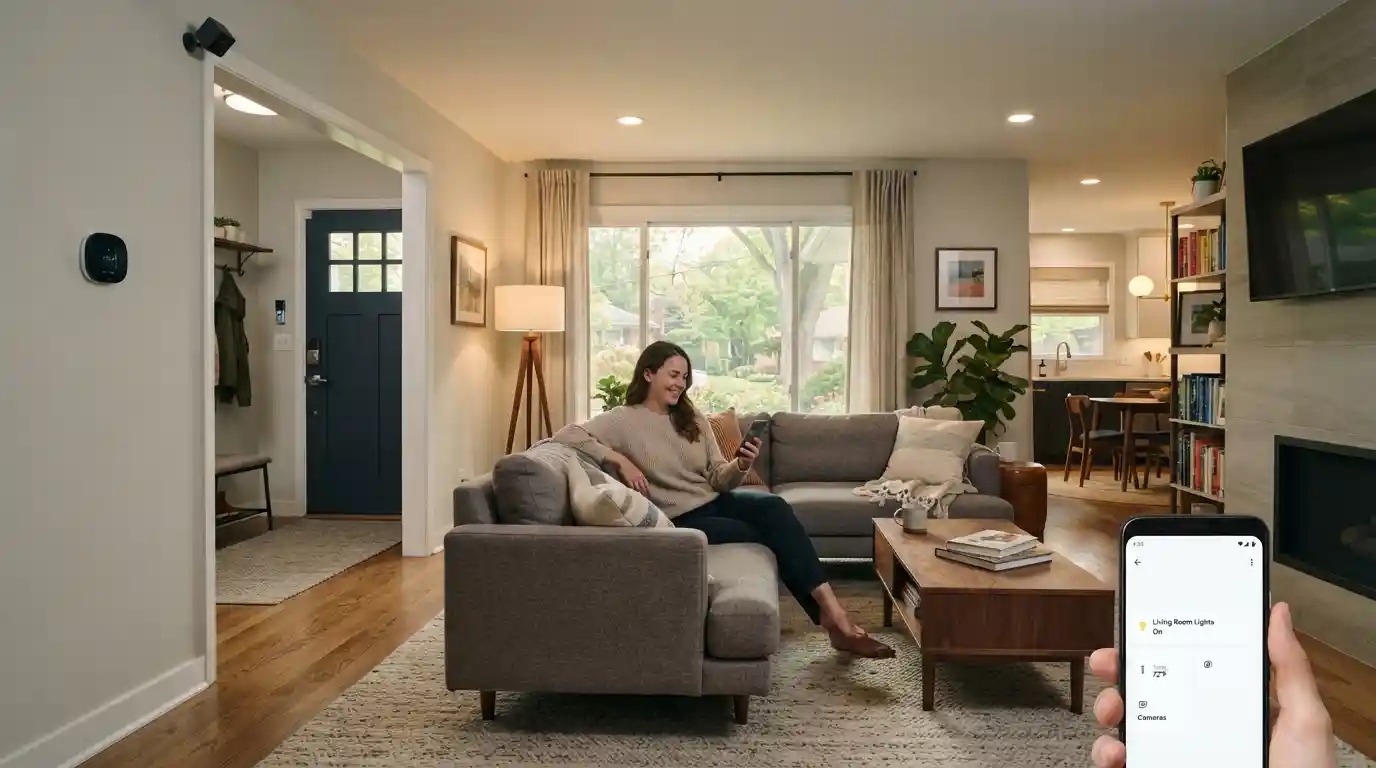
For homeowners considering home automation services in Missouri, the biggest opportunity is not simply adding more gadgets. It is designing a system that solves practical household problems and remains useful as technology, routines, and family needs change.
What Are Home Automation Services?
Home automation services involve planning, installing, configuring, and maintaining connected devices that can communicate with one another. Depending on the property and homeowner’s goals, an automation system may include smart lighting, climate controls, door locks, security cameras, motion sensors, doorbell systems, motorized shades, whole-home audio, and appliance controls.
A professionally planned system can also create routines. For example, a homeowner might have exterior lights activate around a particular time, adjust the thermostat before returning home, or receive an alert when a door or window is opened.
The goal is to make technology work together rather than leaving homeowners with a collection of disconnected devices.
Why Missouri Homeowners Are Exploring Smart Home Technology
Missouri homes can vary significantly in age, size, construction, and layout. That makes flexibility especially important when choosing home technology.
Older homes may require a different approach from newly constructed properties. Likewise, a homeowner interested primarily in energy management will need a different setup from someone focused on security or entertainment.
Homeowners researching home efficiency and professional home sealing can also consider how automation fits into a broader strategy for managing comfort and household energy use.
Key Areas of Home Automation
“`
1. Smart Lighting
Smart lighting can provide centralized control over individual fixtures, rooms, or an entire property. Homeowners can create scenes for mornings, evenings, entertaining, or bedtime instead of adjusting each light manually.
Motion-based controls can also help reduce unnecessary lighting in areas such as hallways, entryways, and utility spaces.
2. Smart Thermostats and Climate Control
Climate automation can make temperature management more convenient. A connected thermostat can allow homeowners to adjust settings remotely and establish schedules based on household routines.
For a broader perspective on how technology is influencing modern living environments, the site’s coverage of student housing technologies provides another example of technology being integrated directly into residential spaces.
3. Smart Home Security
Security is one of the most practical applications of home automation. Depending on the system, homeowners can integrate cameras, smart locks, doorbell cameras, motion sensors, window sensors, and lighting controls.
Instead of treating every security device independently, automation can connect them into useful routines. A security mode, for example, might lock selected doors, turn off interior lights, and activate sensors with one command.
Because connected devices can create additional digital security considerations, homeowners and businesses can also learn from broader discussions about cybersecurity and digital risk.
4. Smart Locks and Access Control
Smart locks can provide alternatives to traditional keys. Depending on the product, access may be managed through codes, mobile applications, or other authentication methods.
These systems can be particularly useful for families, property managers, vacation properties, and homeowners who need more flexible control over access.
5. Entertainment Automation
Home automation can also simplify entertainment. A centralized setup may allow homeowners to control televisions, speakers, lighting, and other equipment from a single interface or through predefined scenes.
This can turn a living room into a flexible entertainment space without requiring several separate remotes and controls.
“`
How Smart Home Technology Can Complement Modern Real Estate
Home technology is increasingly connected to the way people evaluate and use residential property. Buyers may consider convenience, security, energy management, and technology readiness when comparing homes.
Anyone researching the relationship between technology and property decisions can also explore modern real estate technology and property platforms.
Similarly, homeowners evaluating a property purchase can benefit from understanding the wider transaction process, as discussed in real estate transactions and property decisions.
For investors, technology can become one component of a larger property strategy, alongside location, maintenance, operating costs, and long-term demand. Related ideas are explored in real estate investment strategy and finding the right property.
Smart Home Automation for Energy Management
One of the strongest reasons to automate a home is better control over energy-consuming systems. Smart thermostats, lighting schedules, connected appliances, and occupancy-based controls can help homeowners make more deliberate decisions about when systems operate.
Automation does not automatically guarantee lower utility costs. Actual results depend on the home’s construction, equipment, climate, household behavior, and system configuration. However, better visibility and control can make energy management easier.
For homeowners interested in the wider relationship between property improvements and energy solutions, the discussion of solar technology and sustainable energy offers useful adjacent context.
Home Automation and Aging in Place
Automation can also support homeowners who want to make a property easier to manage over time. Voice controls, automated lighting, smart locks, doorbell cameras, and connected alerts may reduce the need to physically operate certain household systems.
This is particularly relevant when considering accessibility, convenience, or aging in place. Technology should be selected around the individual’s actual needs rather than simply adding devices because they are available.
Related discussions about residential support and household care can be found in home care services, trusted home care, and care services for loved ones.
For individuals with mobility considerations, technology should also be considered alongside practical accessibility solutions, such as the mobility equipment discussed in transport mobility equipment.
Choosing the Right Home Automation Setup in Missouri
There is no single smart home package that works for every Missouri property. A better approach is to start with the homeowner’s priorities.
“`
Start With Your Biggest Household Problems
Ask what you actually want the system to improve. Is the priority security, convenience, energy management, entertainment, accessibility, or a combination of these?
Consider the Home’s Existing Infrastructure
The age and layout of the property can influence installation requirements. Existing wiring, network coverage, electrical systems, and equipment should be evaluated before selecting a large collection of devices.
Think About Compatibility
A system becomes more useful when its components can communicate reliably. Before purchasing multiple devices, consider whether they can work together through the chosen control platform.
Plan for Future Expansion
A homeowner may begin with lighting and a thermostat and later add security, locks, shades, or entertainment. Choosing a scalable foundation can make future upgrades easier.
This broader technology mindset is reflected in other WayfareHub coverage, including discussions of technology-driven innovation, technology solutions for modern environments, innovative technology solutions, and technology-focused business innovation.
“`
Professional Installation vs. DIY Smart Home Devices
DIY smart home products can be appropriate for simple projects. A homeowner may install an individual smart bulb, thermostat, speaker, or camera without needing a comprehensive automation plan.
Professional installation becomes more valuable when multiple systems need to work together. A larger installation may involve networking, device placement, security configuration, electrical considerations, automation routines, and long-term maintenance.
The right choice depends on the complexity of the project. A simple connected device does not necessarily require professional installation, while a whole-home system may benefit from professional planning.
What to Ask a Home Automation Provider
Before choosing a provider, homeowners should ask practical questions rather than focusing only on the number of devices included in a package.
- Which areas of the home will be automated?
- Which control platform will be used?
- How will the system connect to the home’s network?
- Can additional devices be added later?
- What happens if one component fails?
- How will user access and account security be managed?
- What maintenance or support is available after installation?
- Which features require subscriptions or recurring fees?
Clear answers to these questions can help prevent homeowners from investing in an expensive system that does not match their actual needs.
Common Mistakes to Avoid
“`
Buying Too Many Devices Too Quickly
More devices do not necessarily create a better smart home. Start with the functions that solve real problems and expand gradually.
Ignoring Network Reliability
Connected devices depend heavily on reliable communication. Poor network coverage can undermine an otherwise well-designed system.
Forgetting About Security
Connected devices should be protected with strong account credentials, appropriate access controls, updated software, and secure network practices.
Choosing Technology Without a Long-Term Plan
Homeowners should consider how the system can evolve. A product that works today may become less useful if it cannot integrate with future additions.
“`
How to Build a Practical Smart Home in Missouri
A practical automation project usually works best when developed in stages.
- Define your priorities: Decide whether security, comfort, energy management, entertainment, or accessibility comes first.
- Evaluate the property: Consider the home’s layout, electrical infrastructure, network coverage, and existing equipment.
- Choose a compatible platform: Select technology that can support your current requirements and possible future additions.
- Automate high-value functions first: Start with features that provide noticeable everyday benefits.
- Secure the system: Protect accounts, networks, devices, and remote access.
- Test the routines: Make sure automated actions behave as expected before expanding the system.
- Review and upgrade gradually: Add new features when they provide a genuine improvement to the home.